
The possibility of winning the jackpot on potential NFT projects always excites NFT investors and collectors who rush to “freely mint” an NFT when they see exciting new projects. With the success of Goblin-town NFTs (which completely disrupted the NFT sector) and Crypto Punks, the first free mint NFT project, new NFT projects are increasingly using the free mint option. Similarly, free mint scams or fake mint NFTs have emerged as the latest trend among NFT scammers due to the popularity of free mint NFT projects.
But are all free mint NFT projects legitimate or just fake mint scams? While sometimes free mint NFT projects might be legitimate, mostly they are almost always fake mint NFT scams that scammers use to steal collector’s crypto assets. Scammers may employ several social engineering schemes or phishing attacks to mislead NFT collectors seeking a free mint. It is vital to check the minting contract of free mint NFT projects for any smart contract vulnerabilities or hidden minting costs before using it to mint your next NFT freely.
The idea of free minting is a new trend in the NFT space which creators of new NFT projects have been employing to boost the sales of their NFT collections.
This article explains a free mint NFT project and how scammers use fake mints to benefit from such ventures. It will further explain distinguishing between a free mint NFT and a fake mint NFT.
What is a Free Mint NFT?
Free mint NFT collections are a kind of NFT collection in which projects allow investors or collectors to mint their NFTs at no cost other than the gas fee associated with minting. In their project planning, such mints tend to prioritize royalties from secondary markets over revenues from primary markets. In other words, the NFT project team receives a certain proportion of royalties for each NFT in the collection that collectors sell on the secondary market.
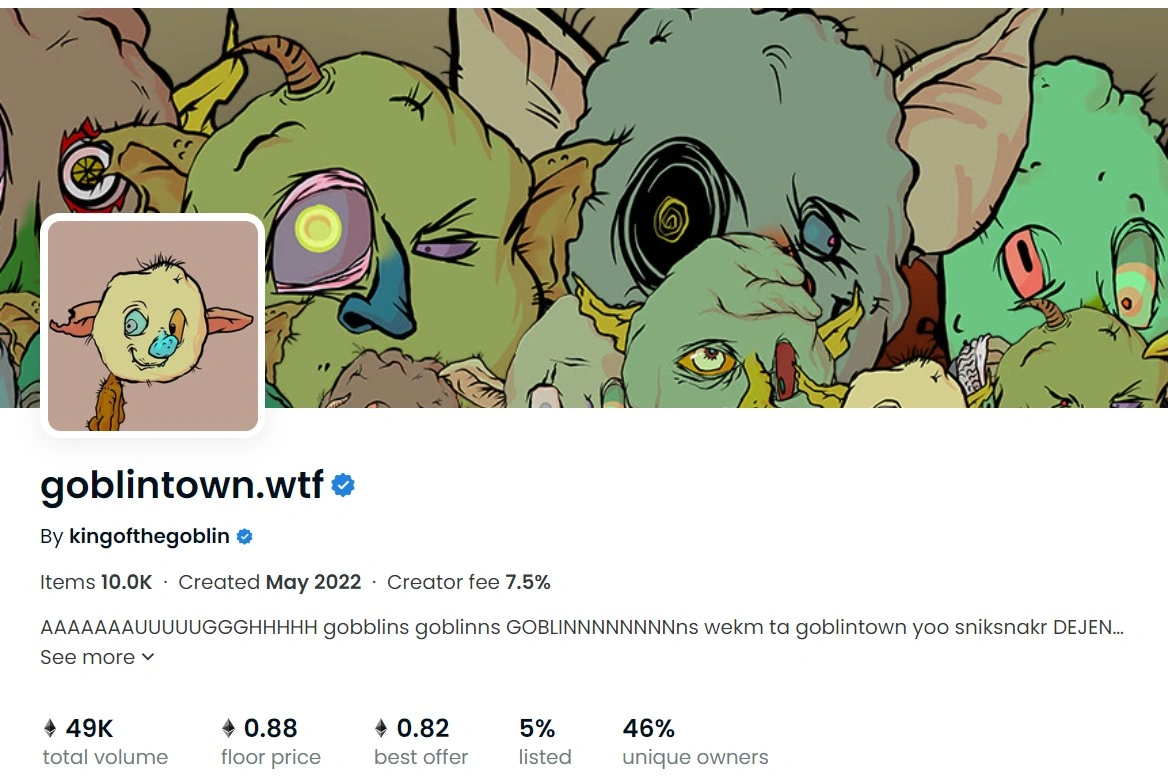
Goblin-town is a popular free-mint NFT Collection. (Source: OpenSea)
Free mints refer to a significant trend gaining traction among NFT projects, owning to the current NFT bear market. The Crypto Punks was the first PFP NFT collection that pioneered the idea of free minting even before NFTs were globally famous and popular.
To put this in perspective, consider how most new NFT projects from last year required collectors to pay a minting fee (falling between 0.5 ETH and 0.25 ETH on average). However, with the current NFT and cryptocurrency bear market and the resulting drop in demand for NFTs, free mints are returning in the NFT sector.
What are Fake Mints?
Fake mints are phishing websites that scammers use to lure in NFT collectors during an anticipated NFT drop. Scammers frequently create fake social media accounts to impersonate popular free-mint NFT collections such as Goblin Town or Okay Bears to scam NFT collectors using different scamming techniques.
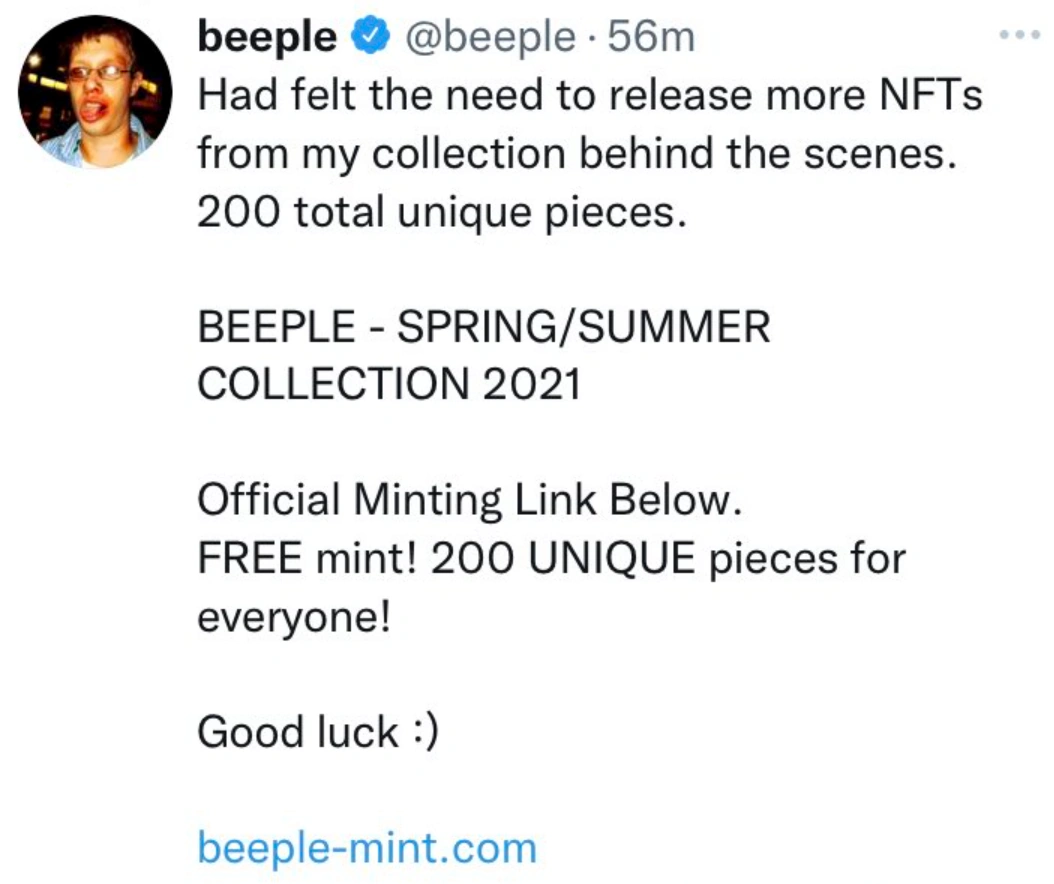
Fake Mint Scam on Beeple’s official Twitter account after scammers hacked it.
Source: xBenJamminx (Twitter)
Such scammers will employ various techniques, including social media hacks, discord bot exploits, site mimicking, and fake NFT marketplaces, to impersonate anticipated free-mint NFT projects. The different fake OpenSea collections and social media accounts that scammer use makes it difficult to determine between a legitimate free-mint collection and a fake mint, particularly if the NFT collection is not even verified.
Unsuspecting NFT collectors often fall victim to such scams and minting on the malicious smart contract or phishing websites (as in the image above) due to a lack of due diligence on their part, driven by feelings of sale rush and hype.
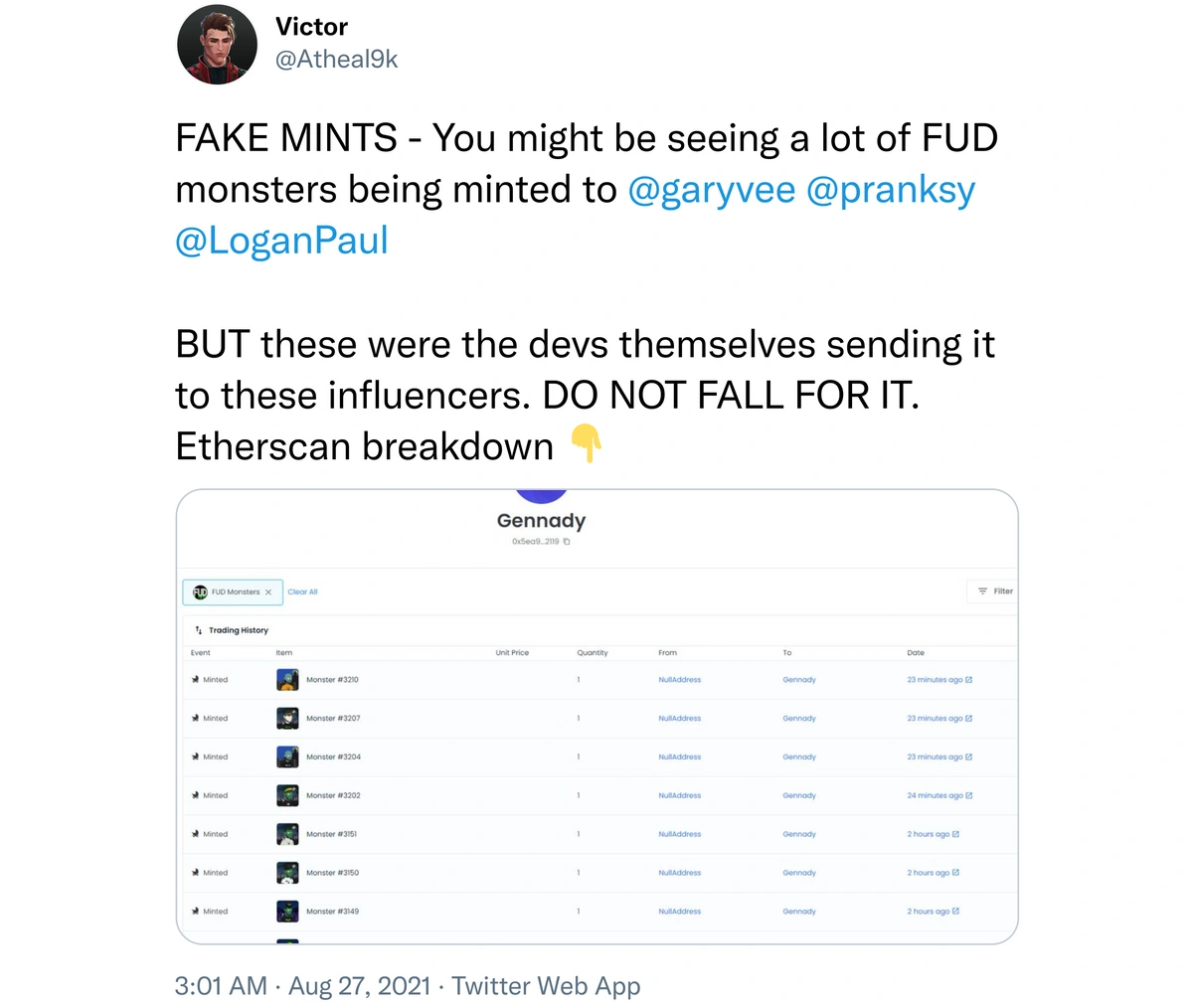
Scammers are making it look like top NFT Influencers are minting NFTs. (Source: Twitter)
Additionally, fake mints may have different types besides impersonation and phishing scams which are relatively the most common NFT scams. Founder of Prime Nine NFT, NFT creator Victor, highlighted a fake mint scam that scammers have used to create a fake impression of NFT minting.
According to the famous NFT influencer Matty (aka DCBlogger), who further highlighted the fake mint scam that victor exposed in a tweet, scammers trick people into believing that leading NFT influencers like Gary Vee, Pransky, and Logan Paul are minting (fake) NFT collection when they are not.
“Devs making it look like NFT influencers are minting NFTs but in reality, it's not the case. They know many people "watch" wallets to see activity.”, Matty said in a tweet.
How to Distinguish Between Free Mint and Fake Mint?
Supply and demand are the driving force behind NFT pricing. First and foremost, you must be aware of any offer that seems too good to be true. Compared to other NFTs of the same collection or genre, a fake NFT will be much cheaper or significantly more costly.
You may verify an NFT's legitimacy using a reverse image search on Google. In addition, social media platforms (such as Twitter) may often verify the authenticity of the NFT collections and their creators. The social media accounts of a genuine free mint NFT collection may have a verification badge, while a fake collection may not have it.
The Takeaway – How to Avoid Fake Mints?
Learning to read and understand NFT smart contracts is crucial for avoiding free mint NFT scams (fake mints). A smart approach to distinguish an actual NFT-free mint project from a scam is to familiarize yourself with the definition of a few fundamental minting functions.
Many experts in the NFT space recommend using a secondary wallet for free mints while keeping your important NFTs in a hardware wallet you never use for minting. When it comes to free mints having a second wallet with a tiny amount of ETH in it will suffice for gas fees. In that manner, a fake smart contract for a free NFT mint (fake mint) won't steal your valuable NFT assets, and you may avoid significant loss.
Alternatively, you may take the following steps to secure your NFT assets and avoid fake mints:
- Avoid visiting any links that you are uncertain of.
- Verify the domain name since a single unique character is frequently all that distinguishes a legitimate website from a scam.
- Please verify that you have the official collection's URL by visiting their Twitter or Discord.
Finally, if you see any fake mint scams like the ones we've highlighted above, please help protect the NFT community by reporting them to NotCommon via our Collection Reports Form. (must be signed into NotCommon to access form)